
[Mortal Things] Chapter 1: Snow on the Rath
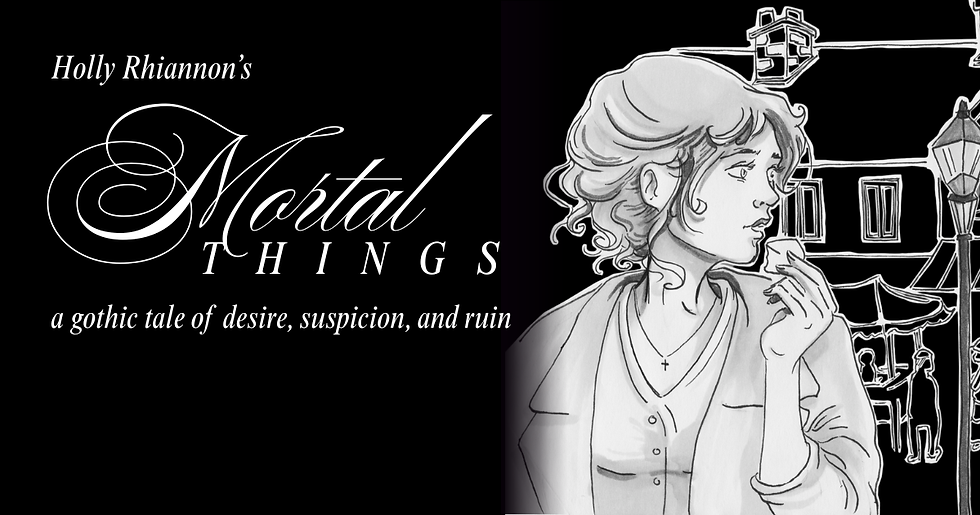
In a quiet Irish village in 1894, dressmaker Bridget Cleary lives between two worlds: the hearth and market stalls, and the one whispered about in fireside tales. When a stranger with violet eyes appears, Bridget learns of a hidden power tied to an ancient rift between realms. Her secret meetings with him draw the attention of her husband and a community quick to see her as something other than human.
Based on a haunting true story, Mortal Things is a gothic tale of desire, suspicion, and ruin.
Porphyria's Lover
By Robert Browning
The rain set early in to-night,
The sullen wind was soon awake,
It tore the elm-tops down for spite,
And did its worst to vex the lake:
I listened with heart fit to break.
When glided in Porphyria; straight
She shut the cold out and the storm,
And kneeled and made the cheerless grate
Blaze up, and all the cottage warm;
Which done, she rose, and from her form
Withdrew the dripping cloak and shawl,
And laid her soiled gloves by, untied
Her hat and let the damp hair fall,
And, last, she sat down by my side
And called me. When no voice replied,
She put my arm about her waist,
And made her smooth white shoulder bare,
And all her yellow hair displaced,
And, stooping, made my cheek lie there,
And spread, o'er all, her yellow hair,
Murmuring how she loved me — she
Too weak, for all her heart's endeavour,
To set its struggling passion free
From pride, and vainer ties dissever,
And give herself to me for ever.
But passion sometimes would prevail,
Nor could to-night's gay feast restrain
A sudden thought of one so pale
For love of her, and all in vain:
So, she was come through wind and rain.
Be sure I looked up at her eyes
Happy and proud; at last I knew
Porphyria worshipped me; surprise
Made my heart swell, and still it grew
While I debated what to do.
That moment she was mine, mine, fair,
Perfectly pure and good: I found
A thing to do, and all her hair
In one long yellow string I wound
Three times her little throat around,
And strangled her. No pain felt she;
I am quite sure she felt no pain.
As a shut bud that holds a bee,
I warily oped her lids: again
Laughed the blue eyes without a stain.
And I untightened next the tress
About her neck; her cheek once more
Blushed bright beneath my burning kiss:
I propped her head up as before,
Only, this time my shoulder bore
Her head, which droops upon it still:
The smiling rosy little head,
So glad it has its utmost will,
That all it scorned at once is fled,
And I, its love, am gained instead!
Porphyria's love: she guessed not how
Her darling one wish would be heard.
And thus we sit together now,
And all night long we have not stirred,
And yet God has not said a word!
In a village built on an old fairy rath, it was said that strange things could happen to sensible women.
Today was the day Michael Cleary would be returning home to his wife, Bridget. Though, returning would not be the most accurate way to put it, as he had never been to Ballyvadlea, the village in which she lived.
It was not long ago that they were married in Drangan, their shared parish. And before that he had courted her in his own home of Clonmel; a larger settlement which Bridget and her family traveled to once or twice a year to sell their wares. Shortly after the marriage however, Bridget’s mother had fallen ill. She insisted on returning home to care for him and her aging father, and help keep the lands.
When her mother passed, Michael knew it was time he made good on his vows, and find work in Ballyvadlea. His own parents were under the care of his elder sibling’s family, and so, his presence in Clonmel was not as essential as Bridget’s in her family home, as the only child. Patrick Boland would need all the help he could get, and it would only be a matter of time for Michael to find an opening for a cooper in his new home.
Bridget had written to Michael many times in their months apart. She had sent pretty words that made him laugh; and wondered if she would remember his face when she next saw him.
I believe my husband is a handsome man, if memory holds true. Tall of stature with large eyes both bright and deep. He has a wide mouth, which when it cracks into laughter, allows you to see every one of his teeth!
Michael knew that he could never forget Bridget’s face, and had stated on many occasions between drinks, "She is too fine to be my wife!"
She called herself plain; a woman lacking noteworthy features. But the moment he had seen her dark eyes, her pale complexion, the hair which had a tendency to run away with itself when she busied herself to the point of ignoring her outward appearance, pouring over her shoulders in wild waves, he was bewitched. When she was a girl, her mother would tell her that she may be one of the fairy folk.
The fairy folk put Michael in a sense of unease. While he knew mothers and daughters joked amongst themselves about such things, he had always believed in the fairy folk and when he’d heard his new home, the home of the Bolands, the best home in Ballyvadlea, was built on an old fairy rath, he had wanted only to take his new wife and her father away from such a place. For now, he would come to terms with it. There were protective measures which could be taken, and he did not have the funds just yet to find them something more suitable.
One day, he would take Bridget and Patrick both to Clonmel and his family; his entire family could be united.
But for now, he was coming home. Home being Bridget. He’d heard word of a possible post in Ballyvadlea and had plans to help tend the land in the meantime. Their home on the fairy rath was a labourer’s home, secured by Patrick in his youth, meaning that he and Bridget had no entitlement to it. He worried that the townspeople would resent this, but Bridget promised that had never been the case.
Bridget however, was not one for gossip, and he had his doubts that she had listened to much of it around market squares and sewing circles as other women of her age would do. For all he knew, Patrick and his daughter were outsiders and he would have to contend with that on his arrival. He had seen how small communities could become viscous and insular, and he did not relish the job ahead were that to be the case.
–
December 1, 1894
My Michael is coming home. He’s heard talk of work in Ballyvadlea. I long for him, though something in me flinches at the thought.
In this time on my own, I have taken work. I’ve a level of independence many women in Ballyvadela or even Clonmel do not. Women about town know me as a dressmaker and milliner: a professional woman. And while my father has had time to adjust, I’ve not written a word of it to Michael.
Of course, he knows I have done mending work for friends and family, but receiving coin for it; for presenting my services to all of Ballyvadlea… it’s unheard of.
I only hope he will understand. My father keeps me well, but I am good at what I do and after time if you do not ask for coin in exchange it’s stranger than if you do. And so, my love for needle and thread, for dress and stocking, has turned into… dare I say… a job.
I’ve even earned enough to purchase a Singer sewing machine—the only one in miles.
And so, on Michael’s arrival, a discussion must be had. Surely, there is enough here for him to be pleased with! His wife earns enough coin for him to have some control over his own work. There is room for rest, for trips to the seaside. His father-in-law, while ill, is a kind and gentle man who has allowed us to secure a house. The best house in town, in fact. One reserved for labourers, as that was the role my father held for many years.
But I do fear my husband’s temper. Michael is a traditional man. He attends his services, he provides for his woman and her family. He has sent my father and me coin during our time apart even though he himself could not come to our town until now. Yes, he is a good husband, but I have seen how it upsets him when traditions are not upheld, and a home occupied by a professional woman is far from what he is used to.
Still, Michael’s love for me is deep. I know this. I see it in his heart, and tomorrow, his heart will beat against mine once again.
–
It was a crisp December morning in Ballyvadlea. The snow had only begun to fall the week prior, making for an unusually late start to the season. Bridget Cleary appreciated a long fall. It was her favourite season, and meant there was more time to keep the chickens in their exposed coop. But today, an inch of snow told her it was time to tidy the small barn and settle them in their new home.
Michael was to arrive in the early afternoon, and it was important that everything be perfect for his arrival. The chickens must be clean and presentable. The home must be clean and presentable. As must she and her father.
Having risen with the sun, Bridget had dressed simply, put her hair in a tight bun and tidied the mending she’d left out the night before. It was a half-hearted effort but would do for now. A pot of hot water was boiling in the kettle and in a moment she’d have warm tea to drink while greeting the sunrise properly. Her father would sleep for a few hours yet, but when he rose the water would still be warm enough to comfort his throat. He had not been particularly unwell as of late but with his growing years, Bridget feared he would be with her mother soon.
With a sigh she crossed the stone floor to the hearth, prepared her tea on a small kitchen table and then crept from the house and out the door to her chickens. The Boland home was one of the best in Ballyvadlea; erected at the expense of the locality and let at a nominal rent. It stood on a half-acre near the public road; one of a few built on a low hill said to be an old fairy rath.
“How d’you do Mary, Ellen, Kate, and just where have you gotten to Margaret?” Placing her cup on top of the coop she unlatched its wire gate and bent down, smiling when she saw her fourth hen tucked in a corner nesting box, almost entirely covered with straw. “Oh ay, it’s cold, I’m well aware of it girls. But don’t you fret, you’ll be all moved into your new home in short order.”
Ducking back out she finished her tea and took a moment to gaze up at the sky. Staring at its endless expanse always set her mind at ease. Today, she wondered if Michael would watch the sky with her at sunrise and at sunset. They had done this in the days after their wedding; that sweet time with one another before the inevitable return to daily life. But Bridget was not naive. She knew what a man does in his first days of saying his vows may not set a standard for married life.
Taking her eyes off the sky, she walked to the small barn and opened its creaking wooden door. It was ready to host her hens; now all she had to do was transport them. And luckily for Bridget, she had a few tricks up her sleeve to ease the process.
“Dia Dhuit, Bridget!”
“Oh! Dia Dhuit, William? How are you this fine morning?”
“Well enough, and how is your father?”
“Still abed I fear,” Bridget laughed.
“You tell him to help you with those chickens! Mucking about with them is no job for a young lady.”
Bridget laughed again, “I fear I’ve gotten used to it, William, and you know as good as any that once a young lady is set in her ways it’s near impossible to break them.”
“Ah yes, that I do, that I do.” William lived only 200 yards from the Clearys and had his own daughters, one known to be particularly fiery. “Is that husband of yours arriving today?”
“Yes, he is!” Bridget felt her face brighten, “and you must come and meet him as soon as you’re able.”
William tipped his flat cap with a nod. “It’s a promise. The family and I must be sure he’s up to snuff.”
Bridget laughed, “I can promise he is, William.”
“Well, you enjoy your chickens and your day, it’s off to market I go.”
“Thank you for the hullo William, slán leat!”
“Slán agat Bridget,” he returned, and continued his walk down the road, disappearing over a hill and into the warming sky.
A breeze picked up and Bridget turned her face to the sky again, closing her eyes and feeling the start of the day rise in her; an energy that would carry her through to Michael’s arrival.
“Alright,” she announced when the moment had passed, “it’s time to get you moved in!”
Walking back to the coop she opened it once again and crept half inside, beckoning the chickens to her. With her father still in bed and her nearest neighbour off to market she wouldn’t face interference again, which meant there would be no questions about her methods of calming her feathery friends.
“Ellen, looks like you’re most keen to go,” she spoke gently to the nearest chicken who was kicking up a bit of a fuss now that her mistress had clambered into the coop. Reaching a hand out, Bridget stroked the creature’s feathers. As she did so, a faint glow emanated from her fingertips, catching onto the chicken in a sparkling aura. Instantly Ellen became calm, eyes fluttering before settling down into a squat; feathers going from puffed in aggression to smooth and flat.
The surrounding chickens watched with great awareness.
“That’s a lovely dear,” Bridget cooed as she took the chicken in her arms, closed the coop door behind her and brought Ellen to her new home.
The process was the same for every other member of the brood and once they were settled into the barn, they seemed quite content; excited even for the space and warmth.
Standing with hands on hips, Bridget surveyed the work she’d done. A beautiful clean new barn with nesting boxes and plenty of warm hay. Happy chickens who would produce eggs now through the winter. Her father, and Michael, would be proud. She was certain of it.
“My daughter! I woke and found you not indoors but out in this biting wind!”
Just exiting the barn, she closed the doors behind her with a laugh. “Biting wind father? It’s merely a cool breeze. Did you have your tea?”
“Yes, yes, but even that is not enough to warm these old bones.”
Patrick Boland was wrapped in a quilt his wife had sewn shortly before her death. The newness of the fabric always made Bridget feel strange. Bridget (the elder) had passed only a year ago but her illness had taken her long before that, removing her memories and making her nothing of the woman she used to be. To Bridget, it felt that everything Bridget had touched should have turned to ash by now.
Yet, here her father stood, a strong man; wiry in his twilight years. Face darkened and full of deep lines from years of labour in the sun. Shivering in a multi-coloured quilt on the frost-peppered grass, while his daughter tended to the chickens.
Was this the life Patrick had imagined? Bridget wondered at times.
“Well, back inside you get then! The fire’s likely gone out by now, we’ll bring it back and have a warm hearth for Michael’s arrival.”
With a nod, Patrick allowed his daughter to usher him back indoors; but not before they both took one last look at the morning sky, wordlessly wondering how many mornings the old man had left.
–
The roads between Clonmel and Ballyvadlea were long and winding, surrounded by fields and forest. Michael had memories of coming here as a boy but could not remember why he had. Still, various curves of the trail and the occasional home or farm stirred a feeling of familiarity in him and caused him to feel that, aside from the sense of home he would have with Bridget, there was something else to this place as well that welcomed him.
Night had begun to fall, earlier than it had in weeks past. Every cottage he passed was lit by lantern and candle; outposts of golden warmth surrounded by frost and bare branches.
Some families were out on their lands, cleaning up fields and putting their farms to bed for the winter. And despite the chill air, all smiled and waved at him as he passed. Yes, Michael could do well here. Like Clonmel, this place was a farming community and every farming community had need of a good cooper to build their barrels, casks, and crates. Having worked around Tipperary for a decade now, he was confident in his abilities.
So, by the time he reached the final stretch of his journey; the Boland home coming into view as his horse-and-cart clambered to the other side of a hill, Michael was feeling content in his decision.
How would she greet him, he wondered. Would she come running to him as the women did in the books she read? Would she expect him to take her in his arms and kiss her under a starry sky? Was he capable of it?
Michael had never been a man of romance but maybe, for her, he could try. She was his wife after all, not some hard woman from the pubs you take to bed after one too many pints. Yes—Bridget was special. Soft of heart and body but sharp of mind. Clever, with a biting humour that had caught him off guard.
You’ve mistaken the bottom of your glass for the top of your game.
Laughing to himself, he remembered the first words she’d spoken to him, when he’d approached her at the pub, quite drawn by her fair cheeks and piercing gaze. What had worked on those hard women had not worked on Bridget Cleary. How she’d fallen for his charms in the end, he would never know, and admittedly it left him feeling less of a man at times, the madness of uncertainty batting about in his head like a hurling ball.
Being away from her had been difficult too; wondering what other men she spoke to, men who had known her longer than he had, who had the benefit of proximity. She’d mentioned a William on a nearby property, but said he was a family man with daughters of his own. How did William look at her; at his Bridget? Michael knew many family men who were less so when they were away from the family home. Did Bridget go out? Did she see him at the pub? How did the two of them behave then?
Suddenly the thoughts that carried him light as air down the road became heavy; a tangled knot in his head, growing in complexity as the cottage too grew nearer and nearer.
She wouldn’t ask for his presence in her letters, speak of longing and quiet weekends, only to turn on him, would she? She did live on the fairy lands after all.

Could a man truly trust a woman who lived on fairy lands?
And suddenly, there she was. Standing at the gate like a beautiful spectre from another world; red lips parting into a smile, illuminated by a gleaming lantern in her hand. The flurries had begun, leaving flakes of twinkling snow in her long black hair which tumbled about her shoulders.
Michael jumped from his horse and caught his wife up in his arms, kissing her under a starry sky; thoughts of uncertainty melting away in a moment.
Holly Rhiannon is a Montréal-based writer of dark fiction. She is the author of A Time When Demons and a regular contributor to The Stygian Zine. Her work has also appeared in The Stygian Collection and 13 Haunted Nights. Drawing on folklore, history, and the supernatural, her stories centre on women, power, and the fault lines running beneath everyday life.
Interested in publishing your own serialized work with The Stygian Blog? Our Stygian Serials program offers paid, chapter-by-chapter publication with professional artwork, promotion, and a path to print. If you have a horror or dark fiction manuscript ready to share, visit our submissions page to learn more and submit your work.

Comments